
A coding agent can implement a feature, write its tests and explain why the work is complete. Building substantial software means deciding what evidence to require before accepting that explanation. Our work on Cutlass Shield made that question practical.
For each piece of Cutlass Shield's build, the workflow assembled an assignment: the requirement, the code it depended on, the engineering procedures to consult and the evidence expected at completion. A Claude Code agent implemented the change and tested it. Separate agents then examined the work from the perspectives of requirements, correctness, security, test coverage and code quality.
Their findings determined what happened next. A change could be accepted, returned for correction or held for a human decision. The task file retained the review history, so the next cycle could work from the objections already raised.
A single human operator directed this development workflow. The operator shaped requirements and design, resolved escalations, inspected results and decided when to advance. Claude Code carried substantial implementation, testing and review work between those decisions.
At AppHelix, we used this approach to develop Cutlass Shield, the agentic tool we use to investigate and validate security findings. Preparing the work for the agents was a substantial engineering task of its own. We built a system of task definitions, reusable skills, commands, hooks and records, then revised that system as the work exposed its weaknesses.
Giving the agent a reviewable assignment
Cutlass Shield spans several kinds of engineering: a Python orchestration service, a TypeScript user interface (UI) for operators, a Go execution agent, database schemas, signing components and isolated execution environments. A change in one area can create an obligation elsewhere. A new field needs consistent treatment in the database, application model, interface and tests. A workflow can call an activity whose implementation has never been assigned to anyone.
The initial decomposition on 30 May 2026 produced 154 work items. By 25 July, the recorded manifest had grown to 196 as the build exposed missing work and the scope developed. We called these items morsels.
A morsel was a Markdown file with structured metadata. It linked a bounded assignment to the requirements and technical specification, named the files expected to change, identified dependencies and set acceptance criteria. It also carried relevant skills, known failure cases, review history and any escalation.
For a database migration, acceptance could require a forward-and-reverse migration check, the columns specified by the requirements, correct indexes and compatibility with the application model. That gave the implementer a concrete target and gave reviewers several ways to challenge the result.
| A morsel records | The engineering question it helps answer |
|---|---|
| Requirement and specification references | Which behaviour or constraint justifies this work? |
| Dependencies and expected deliverables | What must already exist, and where should the change appear? |
| Acceptance criteria and failure cases | What needs to be demonstrated, including when things go wrong? |
| Relevant skills and an owner role | Which established methods should the implementer consult? |
| Review history and escalation state | What was challenged, what changed and what still needs a decision? |
The work moved through explicit states: waiting for dependencies, ready, claimed, under review and done. A separate blocked state identified work that required an operator decision. The dispatcher could select eligible work from the queue, while a returning session could inspect what had happened before it arrived.
Decomposition itself needed checking. Early in the build, zero-prefixed identifiers were written as unquoted numbers in YAML, the metadata format used by the work files. The YAML 1.1 parser interpreted values such as 0040 as octal numbers, turning that identifier into 32 and corrupting dependency relationships.
The correction reached several places. The work-file reader rejected numeric identifiers and dependencies, the decomposer's instructions required quoted strings, the initial work items were re-emitted, and regression tests covered the error. Repairing the manifest alone would have left the generator free to repeat the mistake.
Four mechanisms, with different jobs
The build strategy assigned distinct responsibilities to Claude Code's extension mechanisms. The distinction helped us decide where a new requirement or a lesson from a failure should live.
Subagents performed bounded reasoning work. An implementer worked on a morsel; reviewers examined it from specified perspectives. A separate context gave a reviewer room to investigate the source and requirements without filling the main conversation with every intermediate result. Each role had an explicit review assignment.
Skills carried reusable engineering procedures. These were documents describing how to perform recurring work: author a database migration, use a service interface, test a component or examine conformance to a specification. An implementer consulted the relevant skills alongside the task and existing code.
Slash commands coordinated the work. The batch command described how to select eligible morsels, dispatch implementation, assemble reviews, handle requests for changes and record the outcome. It gave the operator a repeatable way to initiate a batch.
Hooks ran at defined workflow events. They restored session context, checked selected actions, returned lint feedback or updated records. Git pre-commit checks added another point at which code and repository conventions could be examined.
These descriptions concern the roles we assigned in Cutlass Shield's build. The useful distinction is between supplying knowledge, asking for judgement, coordinating work and executing a particular check. A written instruction to follow the logging convention and a check for prohibited logging calls contribute in different ways.
Supplying the context for each change
We used a general implementer role across domains. Its assignment determined the context it read.
A morsel named an owner role, and that role had a manifest pointing to the appropriate skills and specification sections. The morsel could add more specific skills. The implementer also read the relevant dependency code. Database work therefore brought different procedures into context from console work or orchestration work, without requiring a separately designed agent for every speciality.
Consider a change to a Temporal workflow. Temporal coordinates long-running application processes by recording their execution history and replaying workflow code against it. Cutlass Shield's guidance required workflow code to remain deterministic, with operations such as database access and network calls placed in activities. The implementer needed that architectural constraint while producing the change.
The same principle applied to signing, secret handling and interface design. Each recurring concern had a place in the environment where the agent could find the relevant method before attempting the task.
Progress also had to survive the end of a conversation. Morsel files, the manifest, source code, architecture decisions, build state and the journal stored the project record. A session-start hook restored orientation from those files. Subagents returned bounded summaries, while the detailed work and evidence remained available in the repository.
That arrangement let the operator clear a long session and resume from recorded state. A returning agent could find the accepted decisions, completed dependencies and unresolved questions without reconstructing them from a long conversation. The manifest also gave the operator a way to inspect and reconcile progress.
Implement, challenge, revise or escalate
The implementer wrote code and tests, ran the applicable checks and returned a structured account of the change. The batch workflow then dispatched reviewers with different assignments.
The standing review roles covered requirement conformance, code correctness, security, test coverage and code quality. Design-conformance review joined for relevant interface work. Screen-porting work could also receive a bundle-fidelity review, checking the implementation against the supplied design handoff.
Each reviewer could approve, request changes or escalate. An approval from one role did not settle questions assigned to another. The requirement reviewer examined whether the work matched the intended behaviour. The correctness reviewer investigated whether the implementation worked. The test reviewer examined what the tests established and what they omitted.
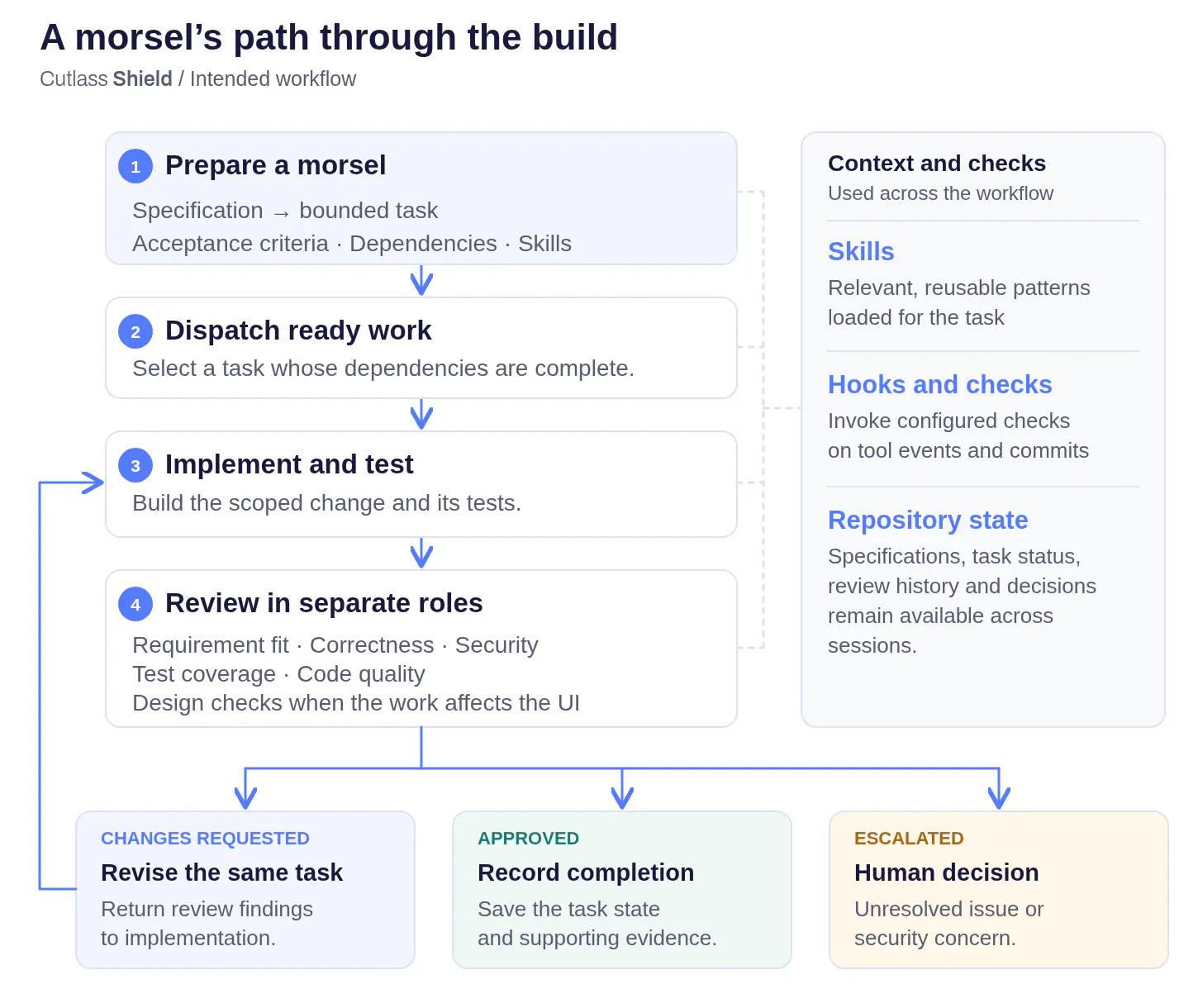
Requests for changes returned to the implementer with the review feedback and earlier decisions. The workflow bounded this loop at three review cycles. Persistent major conformance gaps could trigger earlier escalation after two cycles without improvement. A critical security escalation went directly to the operator.
Those limits addressed a practical failure mode: an agent can keep revising its answer without resolving a flawed interpretation of the task. At that point, the operator may need to clarify the requirement, revise the assignment, accept a justified objection or defer the work.
The implementation path also needed a fallback. The journal records sessions in which delegated implementation failed or fragmented. The main session completed the affected work and submitted it to the same review panel. The authoring path changed while the review requirements remained in place.
Making checks specific enough to help
Cutlass Shield's build used checks at several points. Some ran after a file was written, so the agent received lint feedback while working. Others ran before a commit. Architectural checks addressed conventions such as keeping non-deterministic operations out of workflow bodies, routing logging through the project helper and restricting use of the signing library to its intended module.
These checks made selected expectations executable. They reduced dependence on an agent remembering to inspect every convention unaided.
Their behaviour still needed examination. Some runtime hooks warned or recorded an event. Some rejected particular actions. Several runtime paths allowed work to continue if the hook could not read or interpret the expected state. A warning after a command executes cannot prevent that command, and a failed-open check cannot be treated as a hard boundary.
Anthropic's hook reference likewise distinguishes events that can block an action from those that occur after it. The word “hook” describes an integration point; its script, event and failure behaviour determine what it can establish.
The checks were therefore part of the software being engineered. They needed correct inputs, useful failure messages and tests of their own. A deterministic script will repeat a faulty rule as consistently as a correct one.
Following one morsel through the workflow
The logging assignment, morsel 0002, makes the sequence concrete. It concerned the service's structured logging, including removing secrets from the output. The implementer had the technical specification and the product's requirement that secrets must not appear in transcripts.
The code-correctness reviewer then found a problem in the proposed redaction pattern: it did not match the key formats it was supposed to remove. The same pattern appeared in the technical specification. The implementation could conform to its instructions and still fail its purpose.
The reviewer escalated the issue because the repair crossed an ownership boundary. The code was editable within the build loop; the technical specification was an operator-controlled document. The accepted architecture decision record, ADR-0056, recorded the corrected approach and superseded the faulty example.
The implementation changed, and a test checked that a representative key was redacted in the rendered log output. The decision also recorded that the pattern list would need maintenance as key formats changed.
This single assignment used several parts of the environment: a bounded task, specification context, implementation, a separately assigned correctness review, escalation, a recorded decision and an executable check. The correction reached the specification future work would consult as well as the current code.
What the workflow still missed
Separate reviews broadened the questions asked about a change. Their agreement could still miss defects, and the checks themselves sometimes needed correction. Two later episodes made those limits concrete.
The human saw what the reviewers missed
On 21 June, the build journal recorded a console change that passed its checks and received six reviewer approvals. The operator subsequently reported two runtime defects, including effectively invisible primary button labels. Human inspection supplied evidence the automated checks had missed.
The faulty class-merging utility treated a colour token and a font-size token as if one should replace the other. The repair preserved both and added a regression test for that interaction. The journal also recorded the broader omission: component-level success had failed to establish the appearance of the running interface.
That left two obligations. Keep a focused test for the known defect, and inspect the application at the level where the user experiences it. A new assertion about class names helps with recurrence; it does not establish that every page is readable or usable.
A measurement was assuming its answer
A later review found a capability check assigning the number of recalled vulnerabilities from the number of seeded vulnerabilities. The check could report successful recall without measuring what the system had discovered.
The replacement protocol derived the result from recorded observations and introduced a separate NO_MEASUREMENT outcome. When no qualifying runs existed, the output could say so explicitly.
The defect was in the evidence-producing mechanism. Adding more tests around the same assumed value would not have made the claim sound. The repair changed the relationship between the result and the observation it was supposed to represent.
These corrections reached beyond the immediate change. They updated a shared utility, regression tests and the measurement protocol. Earlier findings had changed the decomposer and the technical specification. Subsequent agents could work with those revised materials.
The decisions that remained human
The human operator supplied direction, resolved ambiguity, assessed design and decided how to handle escalations. Design work included sessions in Claude Design and committed handoff material for the implementation agents. Phase transitions required an explicit decision against the relevant evidence.
The operator could also challenge the plan. When work exposed a missing interface or an activity that had never been assigned, the manifest needed additional work items. Declaring the original plan complete would have concealed those gaps.
Completion records themselves required scrutiny. The 25 July 2026 reconciliation recorded 195 of 196 morsels as done. The reviewed build state also retained an open browser-verification escalation attached to an item already marked done, and its integration history did not establish a successful full live run. The tally described the work queue; the unresolved record described a remaining product obligation.
An integrated release needed its own execution evidence and a decision on the remaining obligations. The task count could help plan that work; it could not settle whether the product was ready.
Carrying the lesson into subsequent engineering
In When Years of Engineering Change Hands, we described making an inherited application accessible to coding agents and feeding human review findings back into the engineering environment. We applied that same practice while building Cutlass Shield.
The reusable work included the task definitions, domain procedures, review assignments and checks around the agents. It also included repairs to those mechanisms when they proved inadequate. A procedure earned its place by helping with a recurring engineering task; a new check needed to establish something that an earlier check had missed.
For a team setting up a similar workflow, a useful starting point is one representative change with its acceptance criteria and evidence recorded. Follow it through implementation, review and execution. If a reviewer misses a defect, identify what would have exposed it. If a check reports success, examine the observation behind that result. If an agent cannot resolve the work, preserve the reason in a form a person can act on.
Then change the relevant instruction, skill, check or review procedure, and examine whether it helps on the next change. That is how the environment around the agents becomes more useful through the work.
This account draws on Cutlass Shield's development strategy, build journal, work manifest and decision records reviewed for this article. For Claude Code's extension mechanisms, see Anthropic's documentation on subagents, skills and hooks.


