
A mature application carries years of dependencies, decisions and unwritten knowledge. A thirty-day handover deadline forced us to make that knowledge accessible—and build an engineering environment that could keep learning from the work.

A change of engineering partner can be agreed in a meeting. Transferring the accumulated understanding that makes a team useful takes rather longer.
Our customer owned both open-source and proprietary learning management system (LMS) products. A change in strategy had prompted an urgent decision to replace its outsourced engineering partner. AppHelix had a month to demonstrate that we could take over with as little disruption to engineering momentum as possible.
The difficulty lay in the application estate: multiple repositories, years of development and engineering processes shaped by the people who had worked within them. For work of this complexity, we would ordinarily allow three to five months for a new team to approach an incumbent's pace. Much of that time is spent discovering where things belong, how they interact and which local assumptions a seemingly small change might disturb.
The customer's concern was reasonable. A capable replacement team can still spend its first months being an expensive audience.
The incumbent's advantage
An established engineering team has an asset that is difficult to put into a handover document: familiarity.
Years of tickets, releases and reviews teach engineers which part of the application implements a behaviour, where related work has been done before and why a particular convention matters. An experienced incumbent knows where to look before beginning to search. A newcomer must acquire that context while trying to make a useful contribution.
The knowledge is distributed. Some lives in the source code, some in tickets and review discussions, and some in the memories of engineers who have repeatedly encountered the same awkward boundary. A requirement may span several repositories even though the user experiences it as a single feature. Understanding an individual function may require understanding the business process around it.
This advantage is earned. The incumbent was once the newcomer and paid the same learning cost. Changing suppliers does not remove that cost from the system.
Ordinarily, we would have worked through it with documentation, knowledge-transfer sessions and progressively more demanding assignments. The deadline required us to accelerate the underlying investigation. AppHelix had been founded on the effective use of AI in everyday engineering. This engagement gave that premise a practical examination.
Making the application queryable
Our intention was to use coding agents as a primary engineering tool. Their usefulness depended on the context available to them.
An engineer can give an agent a ticket and a few relevant files. Selecting those files already assumes considerable knowledge: where the behaviour is implemented, which other components it touches and what is likely to matter. In a handover, acquiring that knowledge is a substantial part of the assignment. We needed the agents to help with the investigation itself.
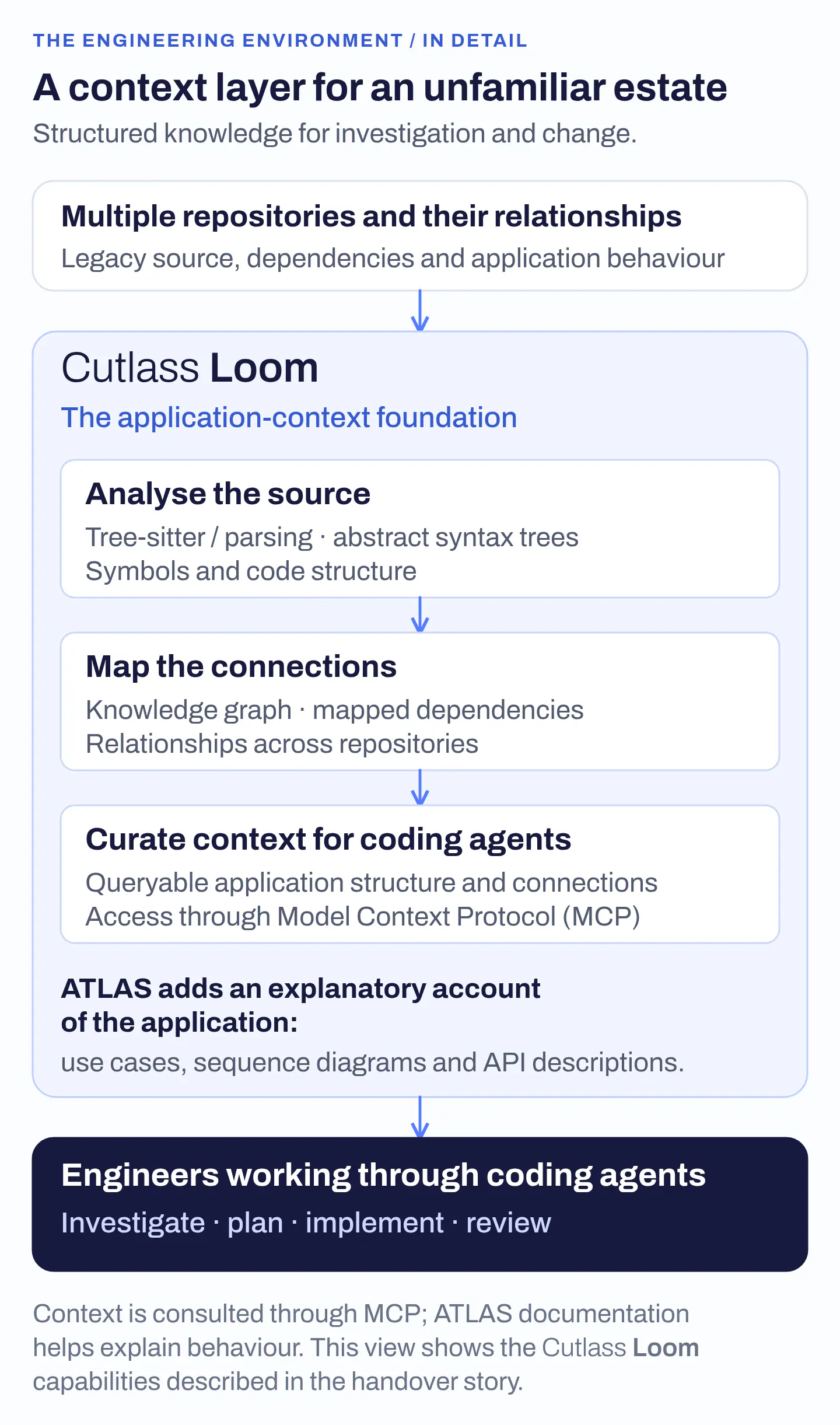
That meant giving them structured ways into the application. We mapped the multi-repository codebase, using source analysis to represent its structure and relationships. Parsing tools such as Tree-sitter helped analyse the source. Abstract syntax trees (ASTs) described code structure. Knowledge graphs connected the mapped elements, giving the investigation a way to follow relationships across the application.
These representations answer different kinds of questions. Structure helps locate the implementation and the elements around it. Relationships help trace connections and identify other parts of the application that deserve examination. The source remains available for inspection when a proposed explanation needs to be checked.
The distinction matters. A search result can identify an interesting file; an application map helps establish what to investigate around it. The aim is to make relevant evidence accessible and its limits visible.
We exposed the prepared context through the Model Context Protocol (MCP), a standard interface through which AI applications can access tools and information. The coding agents could query that context during engineering work. The protocol supplied the connection; the underlying analysis and curation supplied the useful knowledge.
This was the beginning of Cutlass Loom. The immediate need was to make a large, unfamiliar application easier to interrogate, with the answers available inside the tools through which we intended to engineer it.
The context layer became the foundation of the approach. An agent investigating a ticket needed to find the relevant implementation. An agent proposing a change needed to examine related behaviour. An agent reviewing that change needed enough context to question the proposal. Making application knowledge accessible supported all three activities.
ATLAS: from code structure to application behaviour
A structural map still leaves work for its reader. A collection of functions, types and relationships must be connected to an account of what the product actually does.
ATLAS grew out of that need. It maintained documentation of use cases, sequences of interactions and application programming interfaces (APIs), helping engineers move between application behaviour and its implementation.
The different views had practical roles. A use case supplied an entry point from a business question. A sequence diagram showed how parts of the application collaborated. API documentation helped explain the interfaces through which those interactions occurred. Together, they gave the team more ways to investigate a question than starting with a repository directory and guessing where to look.
Documentation also has a relationship with time. As implementation changes, its explanation needs to be refreshed and checked. The purpose of ATLAS was to make documenting the application a continuing engineering activity. A useful account has to remain connected to the code it describes.
Cutlass Loom's context layer and ATLAS therefore served complementary purposes: one made the application navigable to investigation; the other made its behaviour easier to understand. Both supported engineers working through coding agents.
From orientation to contribution
In just over two weeks, we had developed enough understanding of the application to begin actively contributing. That visible progress helped ease the customer's concern about switching to a new team.
Approaching the incumbent's full engineering pace remained a different milestone. What we could demonstrate was that the team had moved beyond orientation into useful work. The customer could assess that contribution alongside our assurances that we could learn quickly.
A newcomer can begin delivering valuable work while still encountering unfamiliar parts of a mature system. The question is whether the team has an effective way to investigate them. The context environment gave us a foundation on which to continue that work.
Learning how the customer engineers
We then turned to consistency. Understanding where to make a change is only part of the assignment. The customer also has expectations about how changes are designed, implemented and reviewed.
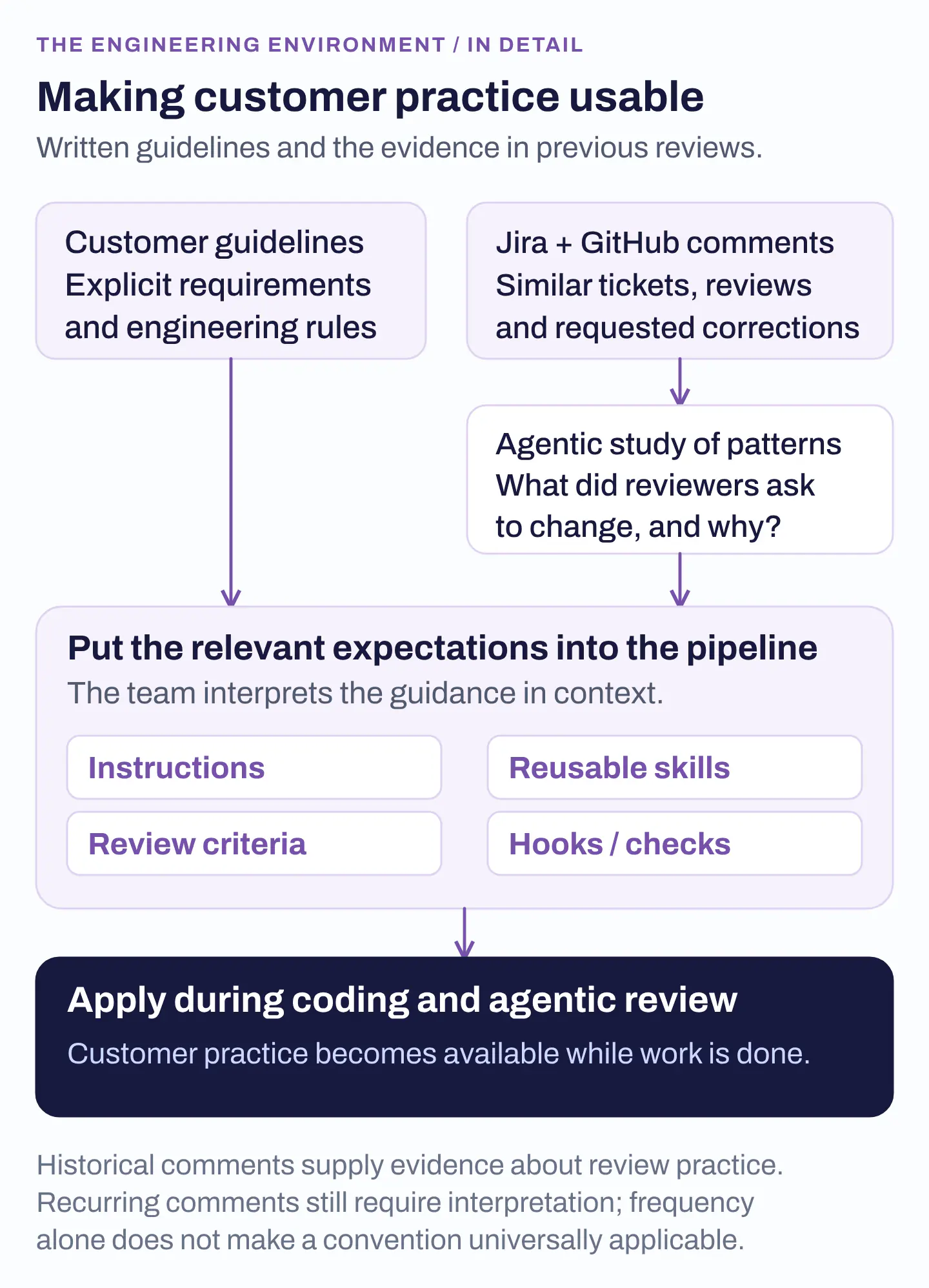
We brought those expectations into the coding-agent engineering pipeline through instructions, skills and hooks. Instructions made project-specific rules available during work. Skills packaged repeatable engineering procedures. Hooks provided points at which checks or other actions could be invoked. Agentic review guidance described what the reviewer should examine.
The customer's written guidelines were one source. Previous engineering work supplied another. We used agents to study comparable tickets and the comments left in Jira and GitHub, learning how reviews were conducted in practice.
Those comments contain information that a standards document can struggle to express. A reviewer may explain why a particular approach is unsuitable, which implication has been overlooked or what further evidence is needed before a change is acceptable. The relationship between the proposed change and the requested correction makes the expectation concrete.
Studying that material helped us develop customer-specific review guidelines and guardrails. The task involved interpreting the comments in context: what was being changed, what the reviewer objected to and how broadly the lesson applied. A correction to one exceptional case should not automatically become a rule for every future case.
The result was a starting body of guidance informed by how the customer actually engineered its products. It could influence implementation as well as review, making relevant expectations available before a human reviewer had to repeat them.
Every review miss becomes work on the pipeline
Historical comments supplied the starting point. New reviews continued the process.
Each time the agentic review missed something that a human reviewer caught, that finding was added back into the coding-agent engineering pipeline. The current change needed attention, and the omission revealed something the engineering environment needed to do better on subsequent work.
This is the substantive meaning of learning in this account: the instructions, procedures, review guidance and checks around the agents changed in response to their misses. The improvement had somewhere to live beyond the comment thread in which the issue was first raised.
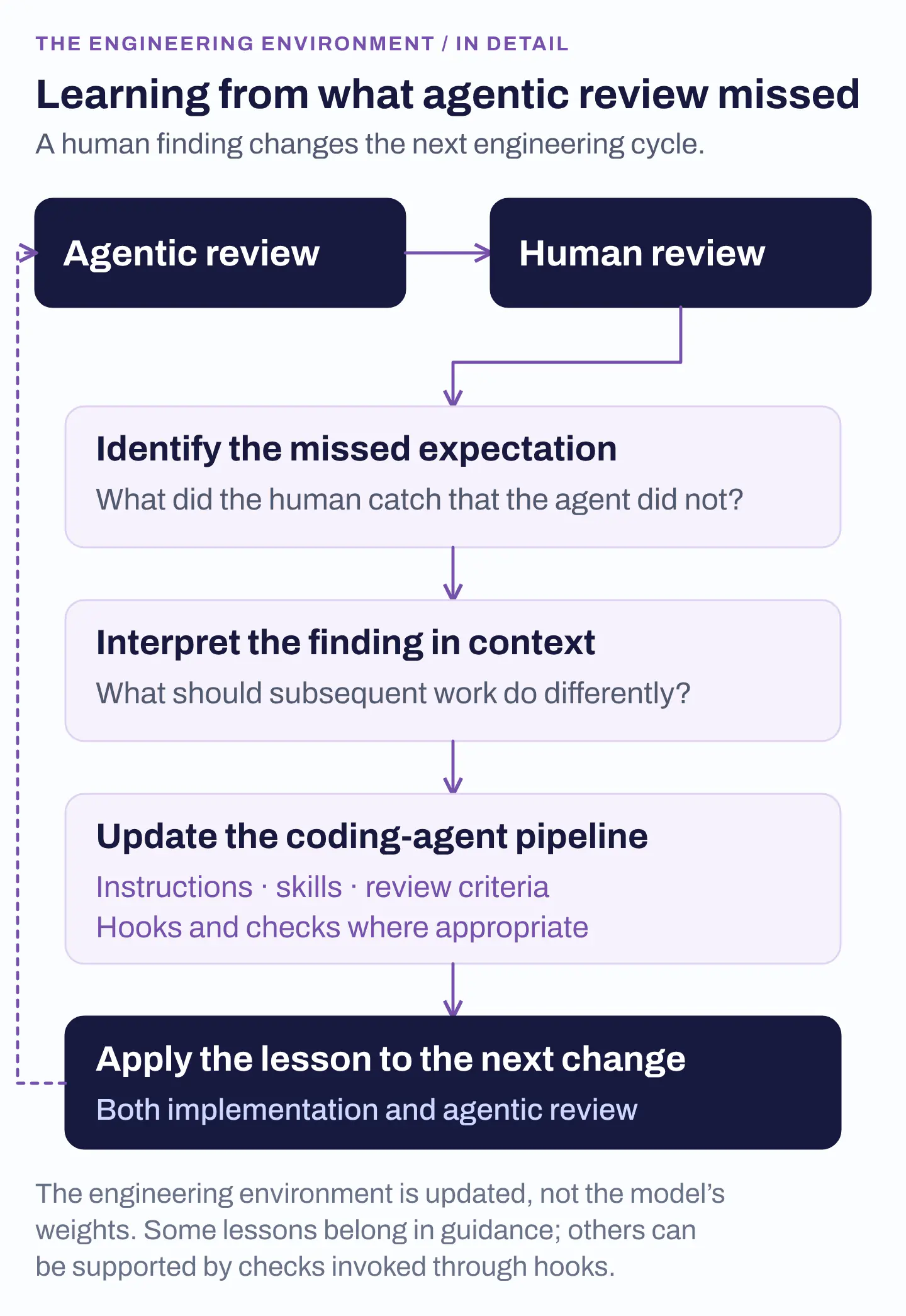
Findings returned to the part of the pipeline where they could influence subsequent work. The response could be an instruction, a reusable procedure, a review criterion or a check:
| Where a lesson belongs | What changes in subsequent work |
|---|---|
| Coding instructions | The agent receives a relevant project constraint while producing the change. |
| Reusable skills | A recurring engineering task includes the investigation or procedure the finding exposed as necessary. |
| Agentic review guidance | The reviewer has a more explicit obligation to examine the issue and its context. |
| Hooks and checks | Suitable checks can be invoked at a defined point in the engineering workflow. |
This distinction keeps the term "guardrail" useful. A written instruction relies on the agent applying it correctly. A hook that invokes a check depends on what that check can actually establish. Review criteria that require judgement remain sensitive to context. Treating these as different mechanisms makes it possible to choose a useful response to a missed finding.
The return path reaches implementation as well as review. A lesson about how a change should be produced belongs in the coding process; a concern requiring separate assessment belongs in the review procedure. Human review helps identify both kinds of omission.
Recording a lesson cannot guarantee that an error will never recur. What it can do is give the next engineering cycle a more explicit expectation or a stronger check. The practical discipline is to make each missed finding change something about how the work is done.
Making UI behaviour repeatably checkable
We also brought Cutlass TestGlide into the work to expand UI automation.
There were two starting points. Some user journeys already had manual test cases. Others lacked UI automation. We used Cutlass TestGlide to automate the former and create automation for the latter, making more of the application's behaviour available for repeatable checking.
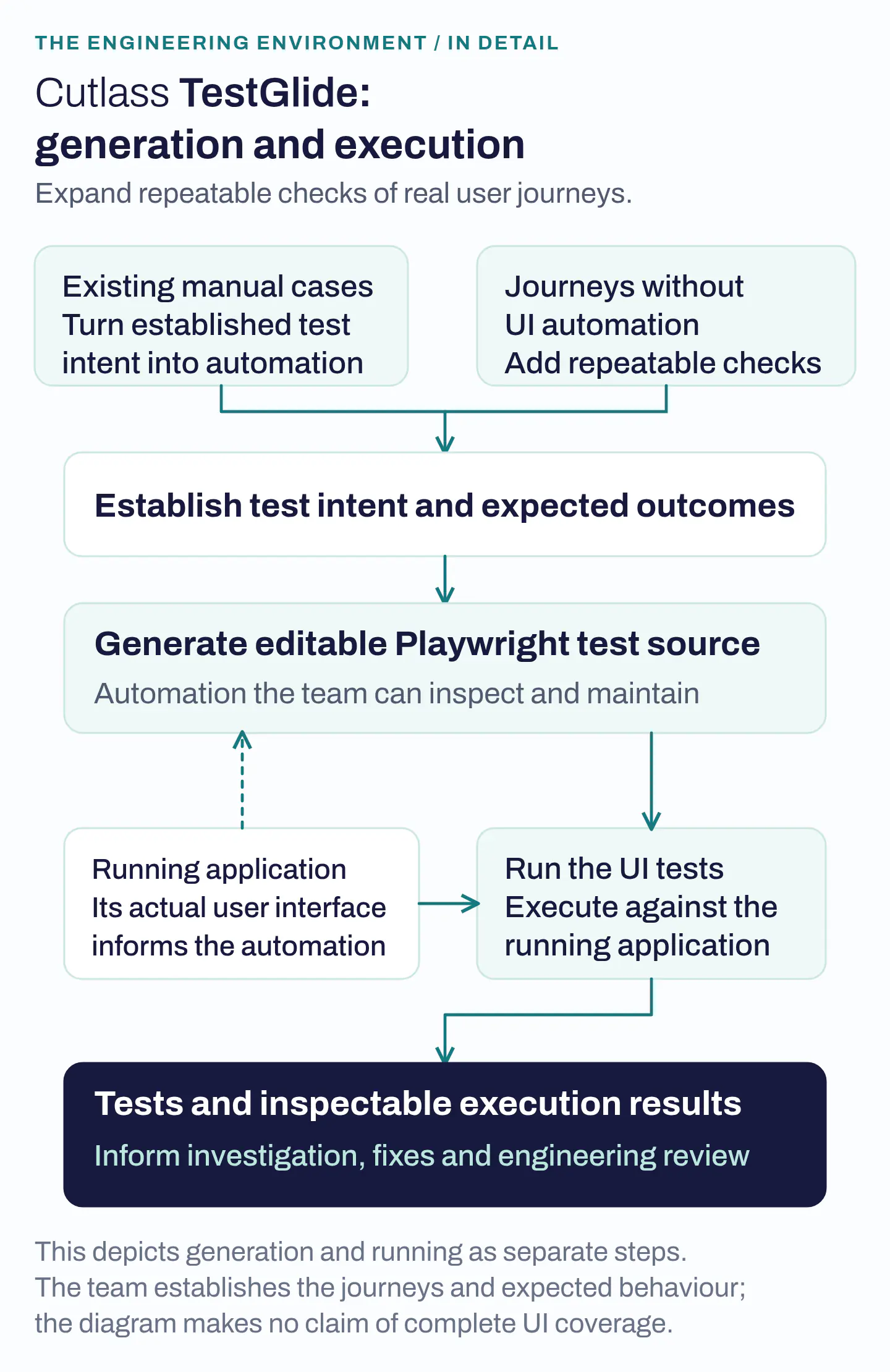
Cutlass TestGlide is an agentic test automation generator and runner. It turns test intent into editable automation and executes it against the application. Its supported inputs include written cases and demonstrated browser journeys; the application supplies the page context needed to relate an intended action to the interface.
The principal generated output is Playwright test code. The team can inspect the actions and expected outcomes represented in that code, run the tests and investigate their results. Generation and execution are both part of the contribution: a script is an artifact, while a run supplies evidence about what happened when the check was attempted.
Existing manual cases carry useful prior knowledge about what should be exercised. Journeys without automation need their scenarios and expected outcomes made explicit. Automation gives those checks a repeatable form; deciding which behaviour matters remains engineering work.
This adds a distinct kind of evidence to the environment. Cutlass Loom supports investigation of the implementation. ATLAS explains application behaviour. Review guidance helps assess a proposed change against the customer's expectations. Cutlass TestGlide exercises selected user journeys against the running application.
The testing path and the review-learning loop address different questions. A failing UI test can expose a problem in observed behaviour. A human finding missed by agentic review exposes an omission in the assessment of a change. Both are useful to the engineering team, and each calls for its own investigation.
Adding UI automation also creates something the team can use repeatedly as the application evolves. The scope of that assurance is the behaviour represented in the tests, and its usefulness depends on maintaining those tests as the product changes.
An environment that accumulates knowledge
The handover began with an immediate business constraint: become useful quickly in an application that the incumbent had spent years learning. In just over two weeks, we could demonstrate active contribution.
The work that followed made the approach more substantial. Application context gave coding agents a foundation for investigation. ATLAS made behaviour easier to understand. Customer guidelines and historical Jira and GitHub comments informed engineering and review practice. Human-caught omissions fed back into the pipeline. Cutlass TestGlide extended the behaviour the team could check repeatedly.
The enduring value lies in making engineering knowledge available at the point where it can influence a decision. A dependency discovered during investigation can help explain the next change. A review finding can alter the next implementation or review. A useful manual test can become a check that is practical to run again.
Every mature application contains years of engineering decisions. The work of taking it over becomes more manageable when the next engineer—and the agents working alongside them—has a better way to find, question and apply that knowledge.


