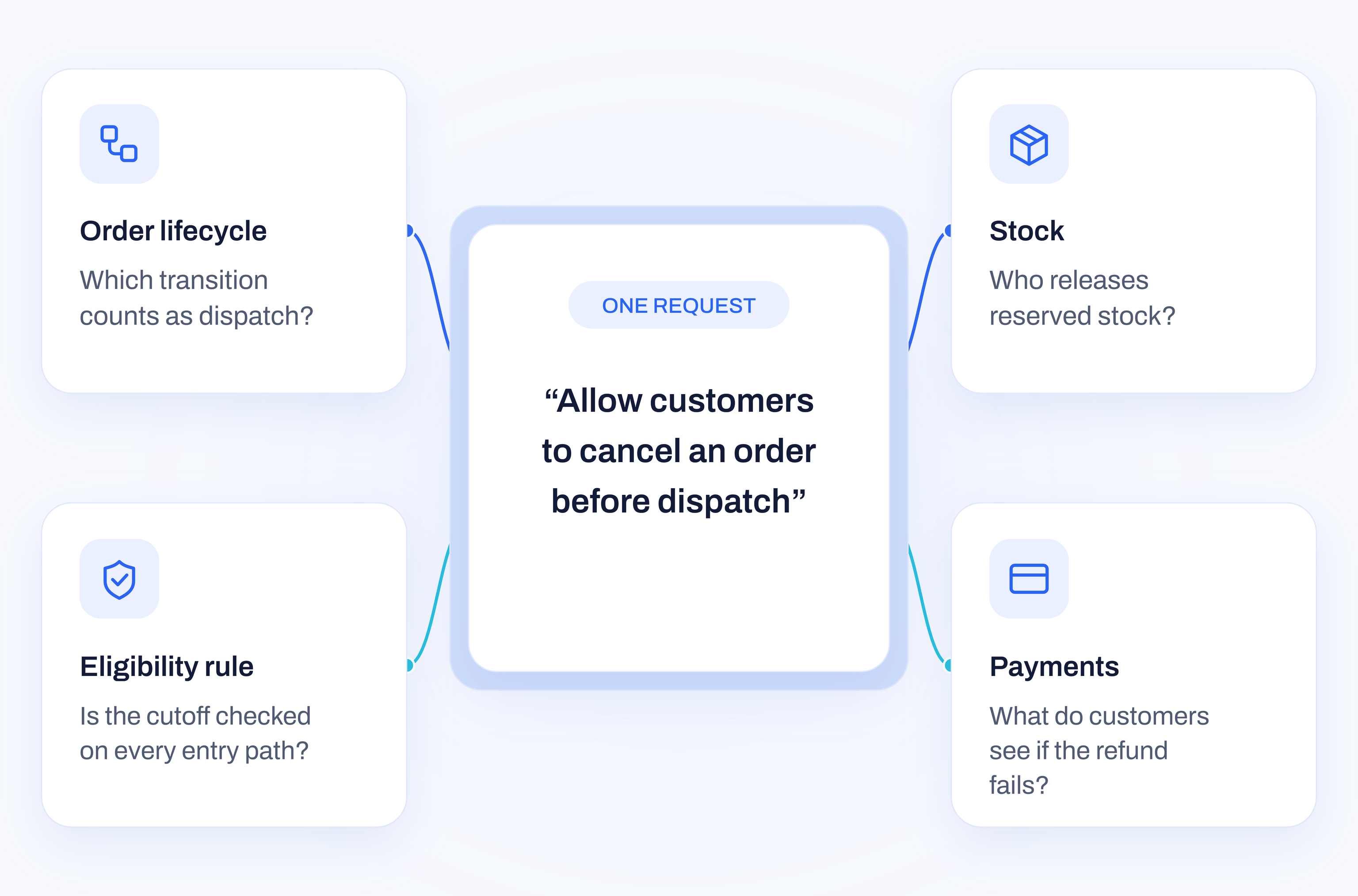
The request “Allow customers to cancel an order before dispatch” touches at least four parts of the code. Someone has to find the transition that counts as dispatch, the check that decides whether an order can still be cancelled, the component that releases reserved stock and the path that refunds the payment. Someone also has to decide what customers see if the cancellation succeeds but the refund fails.
An engineer who has worked on the application for years knows where to look. A new engineer does not, and neither does an AI coding agent. That knowledge is context, and it limits how fast anyone can safely change existing software.

Why context matters
Much of what a team knows about an application is hard to put into a handover document. It lives in the source, in old tickets and review threads, and in the memories of engineers who keep hitting the same awkward boundary.
AI coding agents expose the gap. Give an agent a ticket and three files, and it will produce a plausible change to them. Choosing the files already required the context. If the eligibility rule is also enforced on a second entry path, or a shared operation has other callers, nothing in those three files tells the agent. The change may even pass review, because the reviewer has the same gap.
What a context system gives you
A context system extracts what the code can tell you and makes it queryable. Engineers start from the code that implements a behaviour and plan a change against the code around it, while agents research a ticket themselves instead of waiting to be handed the right files. Each answer cites its source, so a reviewer can check it.
It helps wherever a team must change software it did not write or no longer remembers:
- taking over an application from another engineering partner
- modernizing a legacy system without losing its business rules
- specifying a new feature for an established product
- bringing new engineers onto a large codebase
- running AI coding agents across a multi-repository estate
What we built
We started ours against a deadline. An enterprise education-technology customer was urgently changing engineering partners, and we had thirty days to show we could take over learning platforms spread across several repositories. For an estate like that, we would normally allow three to five months for a new team to approach the incumbent’s pace.
We mapped the code and its relationships and gave our coding agents access through the Model Context Protocol (MCP), the open standard for connecting AI applications to tools and data. In just over two weeks, we understood enough to begin contributing. Approaching the incumbent’s full pace remained a separate milestone, but the customer could now judge our work.
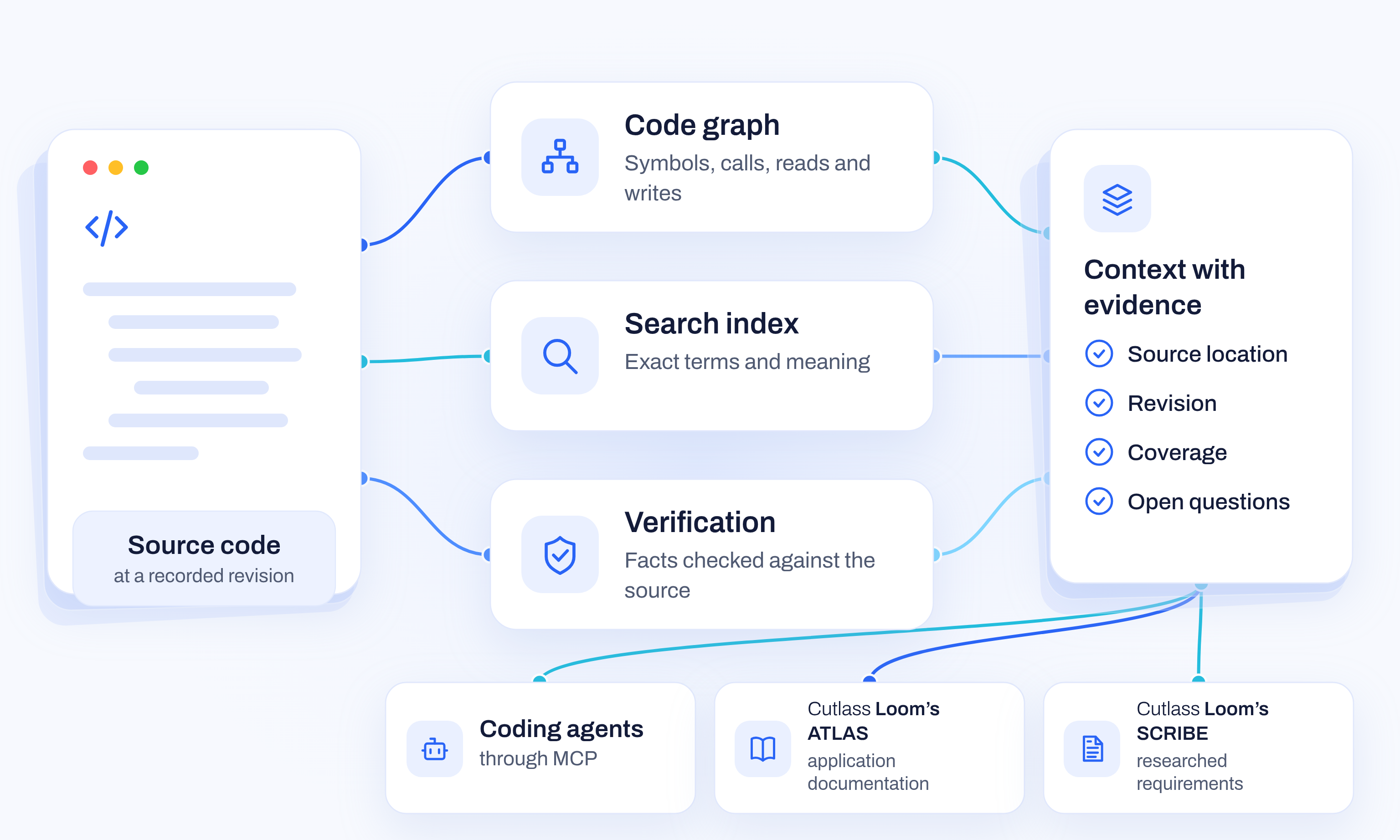
That work was the beginning of Cutlass Loom, which builds context in four steps:
- Index the structure. Language-aware indexing records functions, types and fields and resolves relationships such as calls, reads and writes. Where that indexing is unavailable, Tree-sitter parsing supplies heuristic structure for several languages. The result is a code graph an investigation can follow from a definition to its callers.
- Index the contents. Search combines exact terms with meaning-based matching over function bodies, so a request in business language can find code whose names give nothing away.
- Check before asserting. Before Cutlass Loom treats a candidate fact as established, it examines the evidence at a recorded revision and, when the claim needs it, verifies the fact live against the source. Anything it cannot confirm stays marked as an inference or an open question, and an empty search result states which code it covered.
- Serve it where the work happens. Coding agents query the context through MCP while engineers investigate, implement and review.
On that foundation, Cutlass Loom’s ATLAS documents the application as it stands, from a product overview down to file pages, user journeys and business rules. Each statement is marked as established or inferred and linked to the code behind it. Cutlass Loom’s SCRIBE turns a business brief, even a single sentence, into a product requirements document researched against the code. It separates reuse from extension and new work, and lists the decisions still open.

How we use it
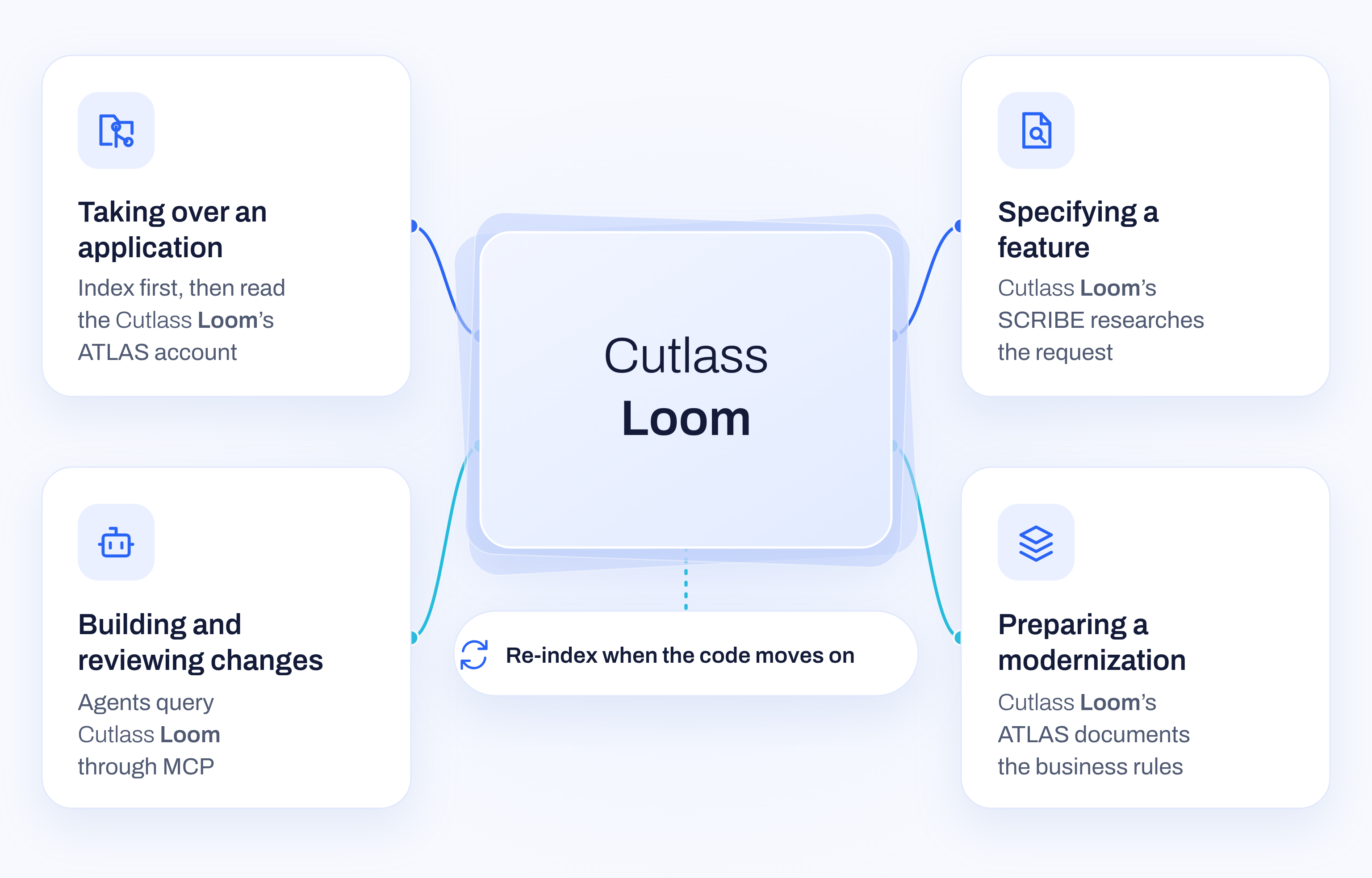
Cutlass Loom is part of our Agentic Toolkit, and we use it in four ways.
Taking over an application. We index the code first, so the team can read the ATLAS account and our agents can query the code from the first ticket.
Building and reviewing changes. Coding agents ask Cutlass Loom where a behaviour is implemented, which callers depend on it and whether a capability already exists. Reviewers check the change against the same context.
Specifying a feature. Before we estimate it, SCRIBE researches the request against the code. Code questions go back to investigation; policy questions go to whoever owns the decision, with a proposed resolution.
Preparing a modernization. ATLAS documents what the application does, including the business rules its code enforces, so decisions about what to keep rest on evidence. We explain why in Rethinking Application Modernization in the Age of AI.

Each re-index builds a new revision beside the old one, and documents and cited facts record their revision, so a team can tell when an explanation describes older code.
If you are taking over, modernizing or extending an application your team did not build, talk to us about starting with its context.